

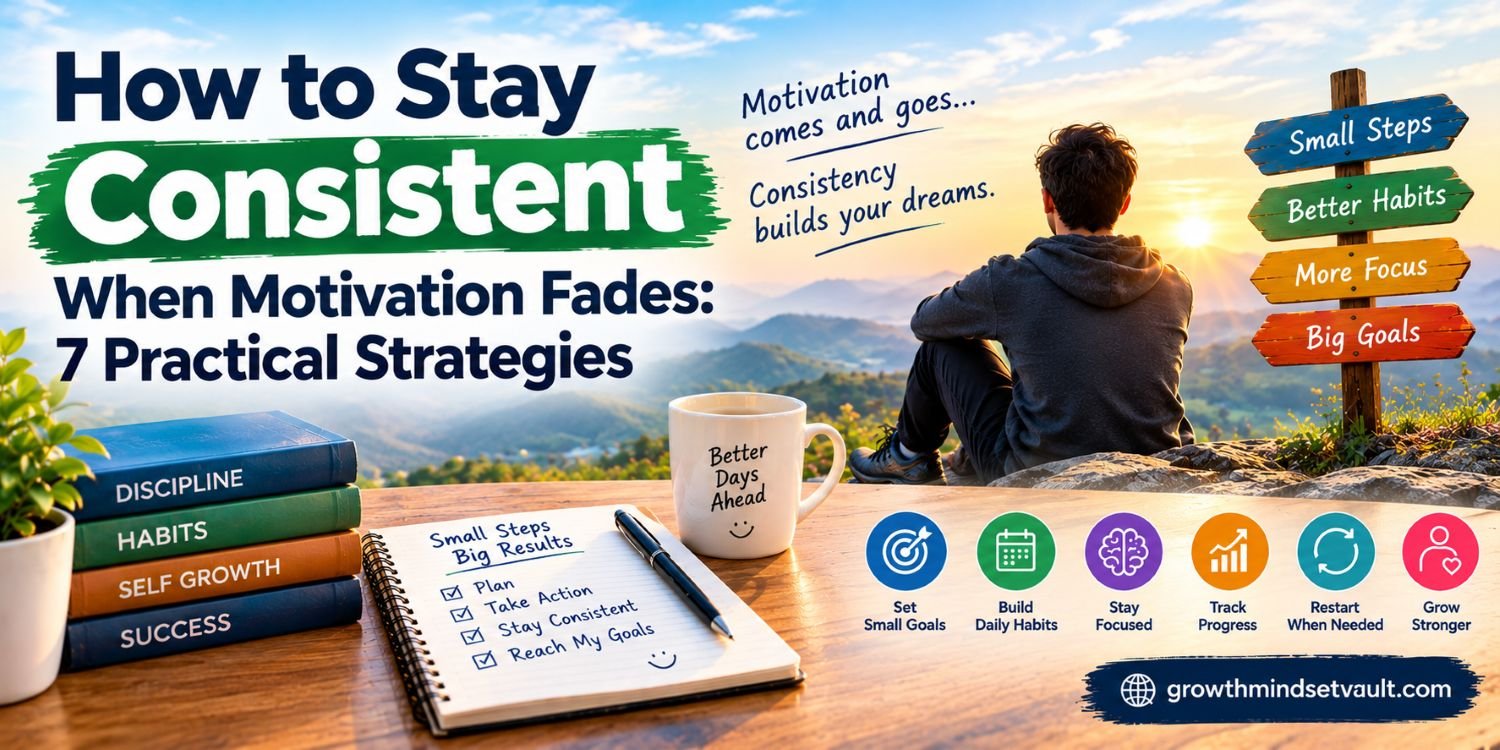
How to Stay Consistent When Motivation Fades
You start a new goal feeling excited.
For a few days, everything feels easy. Then the excitement fades, your routine gets interrupted, and you wonder how to stay consistent.
This is normal. Motivation can change from day to day, while meaningful goals usually require repeated action.
Learning how to stay consistent means creating a routine that still works when you are tired, busy, distracted, or without motivation.
Why Does Motivation Fade?
Motivation can help you begin a new goal, but it is not a constant source of energy.
This is where consistency vs motivation becomes important. You can use motivation to get started, but a practical routine can reduce how much you depend on feeling motivated.
Research on habit formation also challenges the idea that everyone develops habits on the same schedule. A 2024 systematic review and meta-analysis examined 20 studies involving 2,601 participants. The studies that reported time to habit formation found median estimates of 59–66 days, but individual results varied widely, from 4 to 335 days. The researchers also noted limitations in the available evidence.
There is no universal 21-day rule for building a habit.
7 Ways to Stay Consistent When Motivation Fades
1. Start Smaller Than You Think
One of the easiest ways to stay consistent is to make the habit easier to start.
Instead of:
“I will study for three hours every day.”
try:
“I will study for 20 minutes after dinner.”
A smaller action creates less resistance. Once you begin, you can continue longer if you have the time and energy.
Make the habit realistic enough to repeat.
2. Give Your Habit a Clear Cue
Avoid vague plans such as:
“I will exercise tomorrow.”
Make the plan specific:
“I will walk for 20 minutes after breakfast.”
A consistent time or situation gives your behaviour a clear cue.
A 2024 randomized study of walking habits found that participants who planned their activity in consistent contexts developed stronger habit automaticity than those using varied contexts.
This can make a practical difference when learning how to be consistent in life.
3. Make Good Habits Easier
Your environment can either support your routine or create unnecessary friction.
| Goal | Make It Easier |
|---|---|
| Read more | Keep a book nearby |
| Study | Prepare your desk beforehand |
| Exercise | Keep your clothes ready |
| Reduce scrolling | Move distracting apps away |
The less effort required to begin, the easier it is to repeat an action.
Research on digital behaviour-change interventions has identified techniques such as goal setting, self-monitoring, prompts, and cues among commonly used approaches to habit formation.
4. Focus on the Process
Large goals can feel far away.
Instead of measuring only the final result, measure the action you can control today.
| Goal | Daily Process |
|---|---|
| Improve your skills | Practise for 30 minutes |
| Read more | Read five pages |
| Learn a subject | Review one topic |
| Build a healthy routine | Complete today’s planned habit |
This makes it easier to stay consistent with goals because your attention stays on the next useful action.
5. Create a Minimum Version
Some days will not go according to plan.
You may be busy, tired, distracted, or without motivation.
Create a smaller version of your habit:
- Read one page.
- Study for 10 minutes.
- Write one paragraph.
- Practise one skill.
- Take a short walk.
Doing less is often more useful than abandoning the routine completely.
Your minimum version should be small enough that you can realistically do it on a difficult day.
6. Track Actions, Not Perfection
A simple tracker can show what is actually working.
| Day | Habit | Result |
|---|---|---|
| Monday | Study | ✓ |
| Tuesday | Study | ✓ |
| Wednesday | Study | Missed |
| Thursday | Study | ✓ |
If you miss a day, don’t turn it into a judgment about yourself.
Ask:
“What made this difficult, and what can I change?”
This turns a setback into information you can use for personal growth.
Self-monitoring is also one of the behaviour-change techniques frequently used in habit-focused interventions.
7. Learn to Restart Quickly
Missing one day does not erase your progress.
The bigger problem is allowing one missed day to become two weeks.
When your routine breaks:
- Identify what interrupted it.
- Adjust the plan if necessary.
- Start with the smallest version.
- Return to your normal routine.
Consistency does not mean never missing. It means returning to the habit.
That is one of the most useful lessons when learning how to be consistent in life.
How to Stay Consistent Without Motivation
If you are without motivation, don’t automatically assume you need more inspiration.
Ask:
“What is the smallest useful action I can take right now?”
Then do that action.
A short study session, one page of reading, or a brief practice session keeps the behaviour moving forward.
The research does not support one simple formula that guarantees habit formation. Instead, factors such as repetition, timing, context, the behaviour itself, and individual differences can influence how habits develop.
Motivation can help you begin. A well-designed routine can help you continue.
A Simple Consistency Plan
| Situation | What to Do |
|---|---|
| High motivation | Follow your normal routine |
| Low energy | Use the minimum version |
| Busy day | Reduce the duration |
| Missed a day | Restart at the next opportunity |
| Losing interest | Review your reason |
| Progress feels slow | Track your actions |
Final Takeaway
Learning to stay consistent does not mean feeling motivated every day.
It means creating daily habits that are realistic enough to continue when motivation fades.
Start small. Use clear cues. Make good habits easier. Track your actions. When your routine breaks, restart instead of giving up.
You don’t need perfect discipline. You need a system that makes showing up easier.
Explore More From GrowthMindset Vault
For more practical articles on mindset, habits, focus, health, and personal growth, explore GrowthMindset Vault for simple strategies to help you learn, grow, and improve every day.